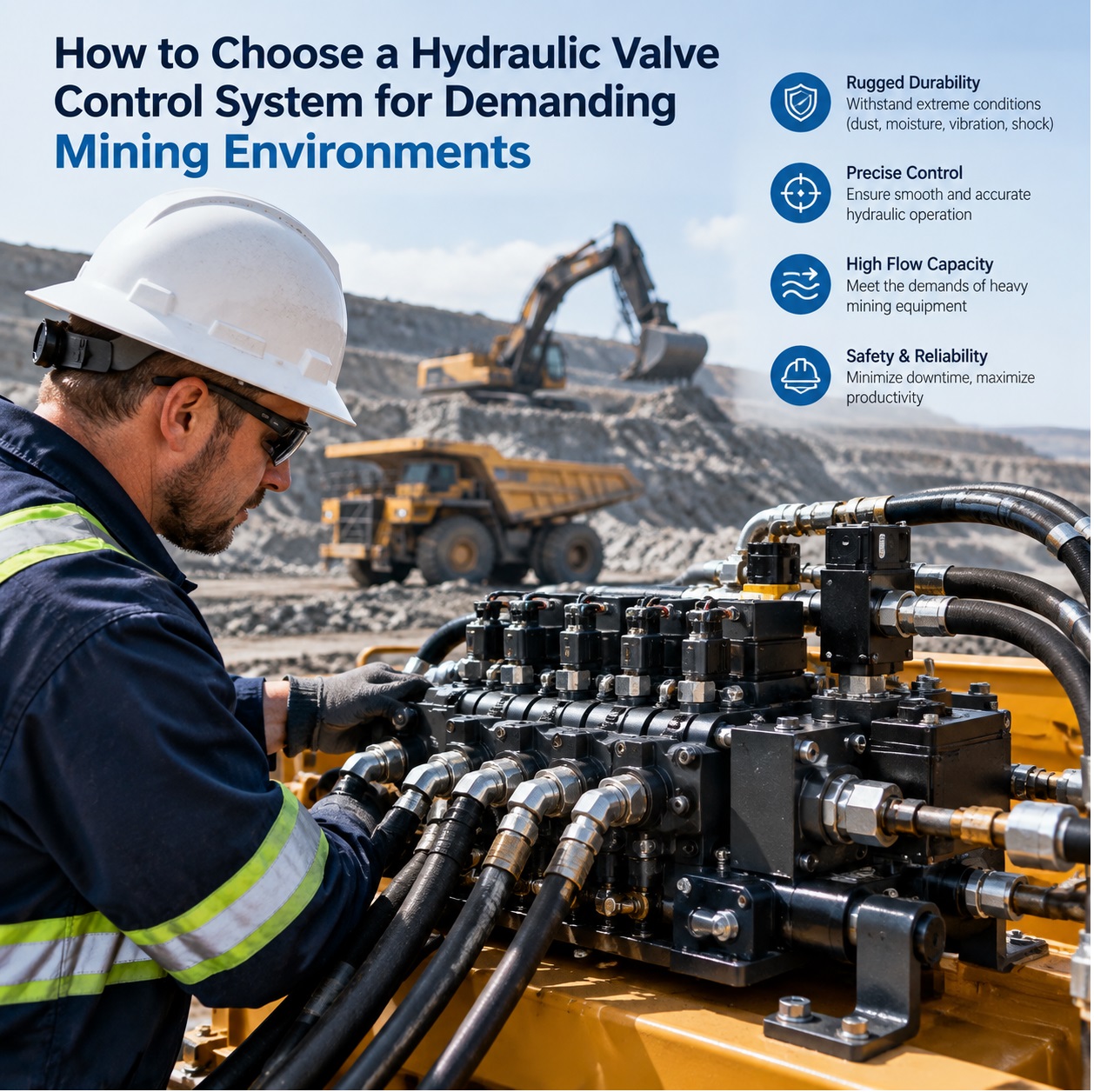
 A hydraulic failure 800 meters underground doesn’t just cost you a valve. It costs you a shift, a crew, a production target, and quite possibly a safety investigation. Anyone who has spent time around continuous miners, LHDs, or longwall shields knows the drill: the part that fails is rarely the one you can reach in a hurry.
So when the time comes to spec a hydraulic valve control system for a mine site, the conversation shouldn’t start with price per unit. It should start with a brutally honest assessment of what the environment will do to that hardware over the next five years. Here’s how to think it through.
Contamination Is the Default State, Not an Exception
In a climate-controlled test rig, hydraulic fluid is clean. In a mine, it is a suspension of rock dust, metal particles, and whatever the last maintenance crew tracked in on their gloves. If your valve spools and clearances aren’t designed for dirty fluid, you’re renting downtime.
Look for systems with generous internal clearances or proven contamination tolerance rather than razor-thin tolerances that demand filtration levels mines rarely sustain. Ask the supplier what ISO cleanliness code the valve actually survives on, not what it prefers. If the answer is “18/16/13 or better,” ask how that’s holding up at sites that don’t achieve it. Honest suppliers will tell you about derating and service intervals. Dishonest ones will quote a spec sheet and disappear.
Pressure Ratings: Headroom Matters More Than You Think
Mining hydraulics live on pressure spikes. A bucket hitting a rock face, a shield advancing against resistance, a winch taking up slack under load, all of it sends transient pressure waves through the circuit that can far exceed steady-state operating pressure.
Choose valves with a rated working pressure that leaves real margin above your system’s nominal pressure. A valve rated exactly at your operating pressure is a valve living on borrowed time. And don’t confuse burst pressure with fatigue-rated working pressure. Burst is a one-time event. Fatigue is what kills valves after two million cycles.
Temperature Extremes Are a Two-Front War
Deep mines run hot. Surface operations in places like the Pilbara or the Atacama run hotter. Arctic operations run cold enough to make seals brittle and fluids viscous. A valve system that performs beautifully at 40°C may leak internally at 70°C or refuse to shift at minus 30°C.
Check the seal material compatibility across your actual operating range, not the catalog range. Nitrile is fine for moderate temperatures. For extreme heat, you’re looking at fluorocarbon or PTFE-based seals. For cold, you need materials that stay flexible and fluids that don’t turn to honey. If your site spans both extremes, that narrows the field considerably, and it’s better to know that before you order twenty units.
Vibration and Shock: The Silent Destroyer
Every component on a mining machine is being shaken apart, slowly. Valve bodies crack at mounting points. Solenoids fail from continuous vibration fatigue. Connectors loosen and corrode. This is where cheap systems reveal themselves, not in the first month but in month fourteen.
Ask about mounting standards, body material, and how the manufacturer validates vibration resistance. Manifold-mounted cartridge valves often outperform traditional line-mounted directional valves in high-vibration applications because there’s less mechanical leverage working against the connections. If the machine is mobile, this matters even more than if it’s a fixed plant installation.
Manual Override and Fail-Safe Behavior
When the electrical signal dies, what does the valve do? In a mining context, the answer to that question can be the difference between a controlled stop and a runaway load. Every valve in a safety-relevant circuit should have a defined fail-safe position, and preferably a manual override that a technician can operate without removing the valve from the manifold.
This isn’t a feature to negotiate on. It’s a baseline requirement. If a supplier treats manual override as an optional extra, question what else they’ve treated as optional.
Serviceability Underground and in the Pit
A valve system that takes four hours to swap out is a valve system that will be swapped out less often than it should be. That means degraded performance, more unplanned stoppages, and eventually a bigger failure.
Look at how the valves are mounted, how accessible the ports are, and whether the system allows sectional replacement rather than full-block replacement. Cartridge-based systems usually win here. So do systems with standardized interfaces across the product line, so a spare on the shelf fits more than one machine.
The Supplier Question You Should Actually Ask
Forget the brochure. Ask this: “Which mine sites are running this exact configuration, and can I talk to their maintenance team?” A supplier who can connect you with real users is confident in the product. A supplier who deflects is telling you something.
Also ask about lead times for spares and whether the supplier stocks regionally. A valve that ships in twelve weeks from overseas is not a spare part. It’s a future production delay.
Total Cost of Ownership Beats Purchase Price Every Time
The purchase price of a hydraulic valve is a rounding error compared to the cost of the downtime it causes. A system that costs 30 percent more upfront but lasts three times as long and swaps out in half the time is not more expensive. It’s cheaper by a wide margin.
Build a simple model: purchase cost, plus expected service life, plus downtime hours per failure, plus cost per downtime hour, plus spares holding cost. Run that model across two or three options. The answer is usually not the cheapest one on the quote sheet.
One Last Thing: Standardize Where You Can
If your site runs multiple machine types, standardizing on one valve platform across the fleet simplifies training, spare parts, and troubleshooting. It also gives you more leverage with the supplier. The mining industry has enough variables. Your hydraulic valve inventory doesn’t need to be one of them.
Pick the system that survives the environment, not the one that looks best on paper. The rock doesn’t care about your spec sheet.